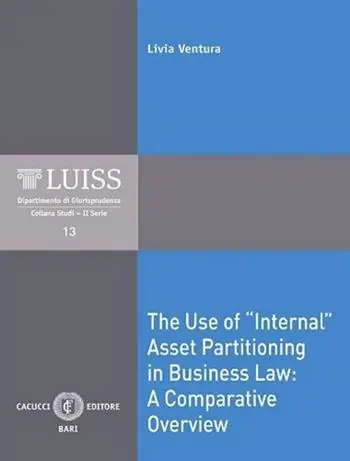
Descrizione
In the last two decades, business organizations asset partitioning has been a highly debated topic in corporate scholarship belonging to several legal traditions. As pointed out by Henry Hansmann and Reinier Kraakman in their seminal work The Essential Role of Organizational Law (published in the Yale Law Journal in 2000), asset partitioning, with its two opposite sides of defensive and affirmative asset partitioning, represents an essential feature of all organizational forms provided by legal systems for carrying out business activities. In particular, the authors highlighted the essential role of affirmative asset partitioning (or entity shielding), which represents the reverse of limited liability, emphasizing the importance of the partitioning effect between a firms assets and the claims of the personal creditors of its owners and managers. Starting from the theoretical framework proposed by Hansmann and Kraakman, this study investigates, from a comparative perspective, the practical use of the internal asset partitioning. The new models of internal asset partitioning (such as the Delaware series, protected cell companies, funds committed to a specific purpose and limited liability individual enterprises) adopted in different legal systems distinguish themselves (shifting from entity shielding to internal shielding) in that the partitioning effect between a firms segregated assets and the claims of both the firms owners personal creditors and the firms general creditors is no longer linked to the existence of a legal entity.In other words, both entity shielding and internal shielding segregate a certain pool of assets from unsecured general creditors claims. Starting from this assumption, this study will analyze several legislations regulating these new forms of internal asset partitioning for entrepreneurs and will investigate their practical use in civil law and common law legal systems. In light of the following comparative law analysis of these internal asset partitioning mechanisms, this study will suggest that the asserted functional equivalence between external and internal asset partitioning (or between entity shielding and internal shielding) is valid only from a theoretical point of view.
| Editore: | Cacucci |
| Collana: | LUISS Dipartimento di giurisprudenza. Studi. II serie |
| Codice EAN: | 9788866118763 |
| Anno edizione: | 2020 |
| Anno pubblicazione: | 2020 |
| Dati: | 270 p.,libro in brossura |